


Why Software Stocks Are Making a Comeback
By datatrekresearch in Blog
Microsoft, Salesforce, and Oracle are up an average of +3.5 percent since the US struck Iran versus the S&P 500’s -1.2 percent decline. In this video, we explain that while recent history shows innovative disruption (Gen AI) can hurt this group even more than a macro shock (2022), users may be more likely to stick with proven existing services amid economic uncertainty. Software stocks can keep rebounding as long as investors perceive these companies as having more stable business models than the average S&P 500 company amid elevated geopolitical tensions.
Watch it here on our YouTube channel! Please hit like/subscribe and share this video if you find it useful. Sign up on datatrekresearch.com to sign up for a 2-week free trial to our daily investment newsletter!
Transcript
Hi, I’m Jessica Rabe, co-founder of DataTrek Research, and today we’re going to explain why we think US large cap Software stocks can keep staging a comeback after getting crushed recently due to concerns about these companies being disrupted by new gen AI tools. For this analysis, we’re going to use 3 well known large cap companies as our proxy for this tech subsector: Microsoft, Salesforce, and Oracle.
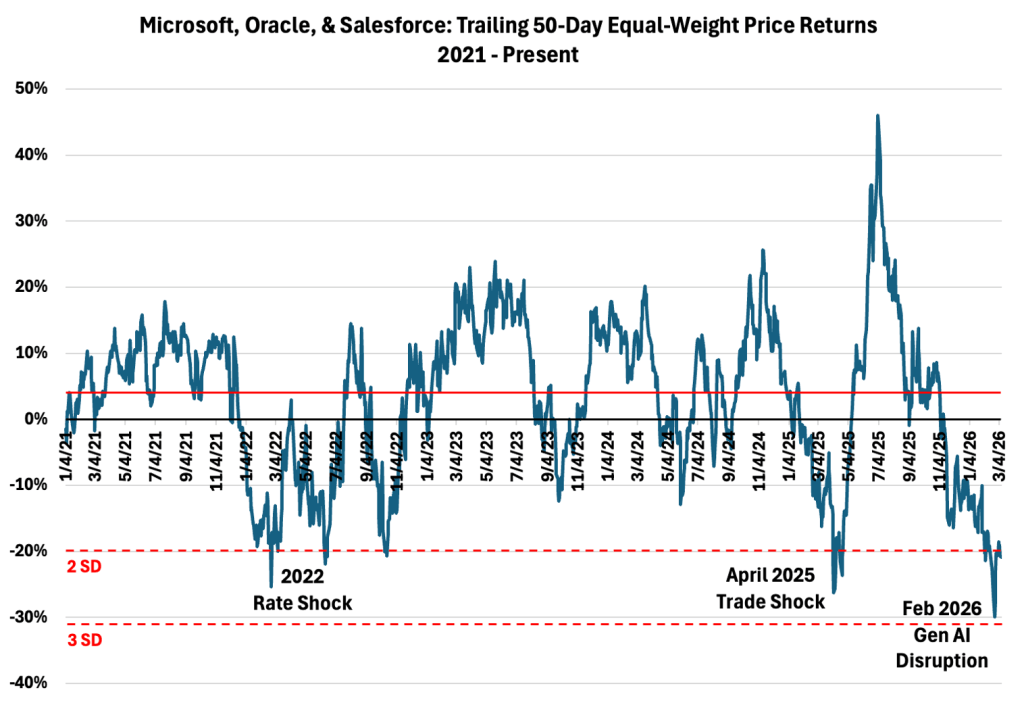
This chart shows the 50-day trailing equal-weighted price returns for these 3 stocks back to the start of 2021. We chose 50 trading days because that is about 2 ½ calendar months, enough time to capture tradable market rotations.
I have four quick points on this chart:
First, this equal weight mini index of Microsoft, Salesforce and Oracle has gained an average of +3.2 percent over any given 50 trading days since 2021. The standard deviation is 11.7 points, making negative 20.1 and negative 31.8 percent two and three standard deviations below the long-run average. I have noted those levels with dotted red lines in the chart.
The takeaway here is that, in the aggregate, these three Software names have tended to be solid performers over the last 5 years, with not only a strong average return, but also a pretty good collective win rate of 64 percent. Yes, Salesforce has been flat over this period, but it has still occasionally contributed in terms of 50 day returns so we have included it in this exercise for that reason as well as its status as an important enterprise Software provider.
My second point focuses on what has proven to be a truly terrible period for US software names, the 50 days ending February 23rd, 2026. That is when our 3-stock Software stock index hit its worst stretch since at least 2021, with a negative 30 percent return. This was nearly a 3 sigma moveand therefore highly statistically significant. Moreover, the aggregate returns of these 3 software giants have only posted a negative 20 percent or greater 50 day return on 29 trading days since 2021, or just 2.2 percent of the time over the past 5 years.
The upshot here is twofold. First, on average, these 3 major Software stocks recently fell more than even during 2022’s aggressive Fed rate hike cycle or 2025’s surprise tariff announcements.That means investors have been more concerned about AI hurting long established Software companies than even very disruptive macro shocks that legitimately threatened the entire US economy with recession.
Second, high valuation Tech names were hurt disproportionately during 2022’s rate shock, a cautionary case study for many Software stocks should oil prices keep climbing and push inflation higher. This would, in all likelihood, cause a US recession, limit the Fed’s ability to cut rates, and push long term yields higher. None of those outcomes would be friendly to names with above-average valuations like Microsoft, with its 23.3 times forward multiple. While Oracle’s forward 12-month P/E ratio is the same as the S&P at 21x and Salesforce is lower at 15x, there are plenty of expensive major software names. Palantir is an extreme case, with its 118 times forward multiple for example. Again, we are just using Microsoft, Oracle and Salesforce as a proxy for the group.
Moving on to my third point now, Microsoft, Oracle and Salesforce have rallied an average of 8.4 percent since bottoming on February 23rd. That’s significantly better than the S&P over the same timeframe, with the market cap weighted S&P down -0.6 percent and the equal weighted S&P down 1.6 pct.
The bottom line here is that three of the US’s largest Software stocks are faring much better than the average S&P 500 stock during the current oil shock. While the Energy sector is usually the most reliable hedge during such events, the 3 names we’ve been covering are up +3.5 pct since the US struck Iran on February 28th. The market cap weighted S&P is down -1.2 pct over the same period, and the equal weighted version fell 3.1 pct.
Overall, recent history shows innovative disruption, such as Gen AI, can hurt Software stocks more than a macro shock, but this group can keep rebounding if the market perceives them as having more stable business models than the average S&P company amid elevated geopolitical tensions. This has of course been Software’s traditional selling point given these companies’ recurring, subscription-based revenue streams. Gen AI has spooked investors because of its potential for replacing traditional enterprise software applications, in addition to the possibility that this disruption could come quickly.
But should the US-Iran conflict persist, companies may be more likely to stick with time-tested, existing services during a prolonged period of economic uncertainty rather than risk adopting new and unproven technologies. While we don’t recommend individual stocks, Microsoft, Salesforce, and Oracle are ultimately market leaders with strong competitive positions, and they are not the only ones. Lastly, Software is one of the few parts of the market working, with momentum in its favor during what’s been an especially difficult investment environment.
With that, thank you very much for taking the time to watch this video, please hit like and subscribe if you enjoyed it. And if you'd like to see our daily research, you can start a 2-week free trial on datatrekresearch.com. Thanks again for watching and we hope you have a great day!
