



When Is The Next Recession?
By datatrekresearch in Blog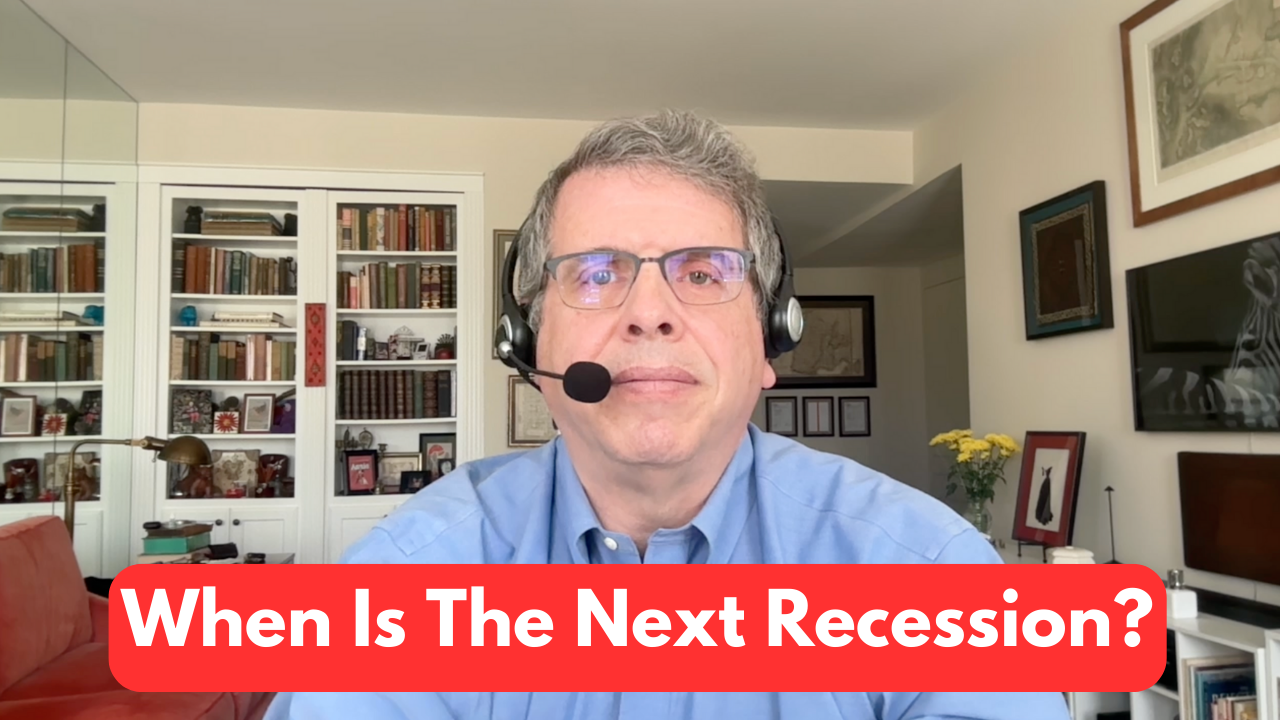
Many institutional investors are concerned about a US recession in the next 12 - 24 months. In our latest YouTube video, DataTrek co-founder Nick Colas 1) explains why they think the American economy may see a slowdown very soon and 2) discusses various portfolio hedges that can help offset this risk.
Watch it here, and please hit the like and subscribe button if you enjoy the video! Feel free to share it as well.
Transcript:
Hi, Nick Colas from DataTrek here and the topic of today's video is recessions. We're going to be discussing a couple of different things. But first, let me tell you why we've been doing this video. We were in Boston two weeks ago visiting with institutional clients and found that many of them wanted to discuss recession risks in the US economy that are happening right now. Even though the economy itself looks to be in pretty good shape, Q1 GDP should run about 2%, nowhere near recessionary levels. And it seems like employment levels are still good and the economy's still chugging along. And yet, a lot of investors were very concerned that the recession might show up in the next 12 to 24 months, and they wanted to prepare for it. So that's why we're doing the video, we're going to do a couple of things over the course of our discussion today.
First, we're going to discuss exactly why a recession is harmful. It's not GDP growth, it's something else, then we'll look at a couple of recession indicators that I like to show clients to give them a sense of where we are in terms of recession coming or not coming, then we'll look at some historical causes of recessions and wrap up with a couple of ideas about how to hedge portfolios against the major sources of recession risk.
This first chart shows you recessions are really not about GDP growth but are really about unemployment. The chart shows US unemployment rates going back to 1948 to the present. And the gray bars that you see are recessionary periods, all the way back to anything after World War II. And what's very clear is that unemployment is the key factor of what makes recessions very painful, not just at a stock market level or capital markets level. But at a personal level.
Unemployment always goes up in recessions, and it goes up by an average of just over three points. So if the economy is running 6% unemployment before a recession, it'll top out at 9% unemployment during a recession. And that delta that increase is what creates the contraction and consumer demand that then slows economic growth. It's very painful, both for the people who are pushed into unemployment, and for investors that are caught unaware of a recession before it starts. But the key issue here is unemployment is the thing that goes up. It's the key driver, the key issue about why we worry about recessions, it's not just the sterile notion of GDP growth.
Couple other statistics before we move on, there have been 12 recessions since World War II, averaging 10 months in length, recessions can last the better part of a year, the average increase in unemployment, excluding 2020, because that was a tough one, because of the pandemic shutdowns is 3.2 percentage points. And the average length of an expansion in between periods of recession runs about five years, 64 months, so you get a good long period of expansion, and then a recession.
This next chart shows you one indicator that we look at every week with clients and that is corporate debt spreads over Treasuries. And then all that simply is how much does a company have to pay in excess of what the Treasury pays to borrow money from the capital markets. As spreads go up, it shows you markets are getting more concerned about recession risk. And as they go down, they're getting less concerned because recessions obviously cause contractions.
In corporate fundamentals companies make less money, they have less money to cover their debt expense. And investors in the bottom market require higher levels of interest in order to compensate them for that risk. And what you'll see starting at the left hand side of the chart is that going into recessions, this market always starts charging companies more than Treasuries for the right to borrow money. And that's obviously very logical. If you see a recession coming, if they worry about it, they're going to want compensation for that risk.
And so you see going into the 2001 recession, spreads went up. Same thing happened going into the big recession in 2007 to 2009, caused by the Financial Crisis. And we've had a couple of scares as well, that didn't turn into recessions. But the 2011 Greek debt crisis, the 2015-2016 recession scare, they both caused spreads to rise, but there was no recession. So this market does give false positives, but it never gives a false negative, it never walks into recession, totally unaware. Even going into the 2020 pandemic recession spreads started to increase very, very quickly. Now, what's important about this chart is that spreads are declining right now and actually at historically very low levels.
So if there's a recession coming, this market has missed it entirely. And that's relatively unusual, it doesn't usually miss the warning signs of recession, and yet spreads right now are extremely low. So from one very important capital market perspective, recession risks are quite low.
This next chart shows you how much analysts expect the S&P 500 to earn over the next couple of years as compared to what they've earned over the last seven or eight years. And while Wall Street analysts aren't great at calling recessions, I think it's interesting to note that they see earnings growth continuing to improve for the next two years, and by quite a bit, 9-10%. So on the analytical side, the analysts don't see a recession coming anytime soon, certainly not one that really pushes earnings down.
Now, the next chart shows you why people are worried and why our clients are talking about this, why a lot of people are talking about this is Wall Street's favorite recession indicator. It shows the difference between 10 year treasury yields, and three month treasury yields over the course of any time from 1982 to the present. And very simply, when three month yields are higher than 10 year yields, meaning that line is below the x axis, a recession inevitably comes along. We saw that in 1988, going into the 1990 recession, we saw in 2000, 2006, 2019. And even though the recessions that subsequently came along, were not caused by short term rates being higher than long term rates meaning Federal Reserve policy being too tight, this indicator does have a really good track record of success.
What's interesting is that the yield curve inverted meaning threes yield more than 10s 18 months ago, and yet we haven't seen a recession. And so while the indicator has been flawless in the past, it hasn't done a very good job of calling recession right now. Meaning we haven't seen big increases in unemployment that really are the hallmark of a recession. Really interesting note here, it's unusual to see something that has a time proven ability to predict important turning points really fail. And yet, that's what the Treasury yield curve has done, at least so far. But again, this issue is probably one of the more important ones for why our clients are worried about a recession. Because you can only go so long with the yield curve inverted before it becomes very clear that the Federal Reserve just has way too high rates or is pushing rates way too high, relative to what the market thinks are neutral rates, which are the 10 year rates. So it's an important chart. And again, one that hasn't worked but might work in the future.
Now, the way we look at things is that the yield curve has an interesting correlation to future recessions. But oil prices are the things that really drive recessions. And simply put, if oil prices go up more than 80% over the course of a year, any given 12 month period, you know, you're going to have a recession almost without doubt. The chart here shows you the year over year change in WTI crude prices from 1987 to 2019. We chopped it off, to cut off the volatility around the pandemic crisis when oil prices collapsed, and then came back kind of screws up the data. But this data here is very clean and very good. And you'll see that in September 1990, oil prices went up almost 100%, we had a recession. Remember, 99 oil prices more than doubled due to a speculative bubble in energy prices. That happened right alongside the dot com bubble. And sure enough, we got a recession. And oil prices doubled in May 2008. And sure enough, we were in a recession.
So the thing I worry about the most and this goes back to my history with markets and everything else, you know, growing up in 1970s, is that oil prices, oil price shocks are the single most common cause of a recession, when oil prices double in a given year or so.
Consumers can't incorporate that change in cost to filling up the gas tank or heating their homes. And so they pull back on spending elsewhere. And that's what creates recessions. And it also reduces a lot of investor confidence as well, because the uncertainty around consumer spending becomes quite high.
So in terms of what really causes a recession in my mind, the number one thing is higher oil prices. And obviously this is relevant today. Because we have some pretty serious political conflicts going on in the Middle East, oil prices have been trending higher. The good news is they're only up about 5% year over year right now. So we're a long way off from the 80 to 100% increases that we need to see to be assured the recession is coming. So sort of good news, bad news. The issue is definitely one that's alive and kicking. But we don't yet have the kind of big spikes in oil prices that are the precursor of a recession in the US.
So summing up, the big reason I think folks are worried about a recession is we're 48 months into the current economic expansion. If the average expansion lasts 64 months, then we've got to be concerned about a downturn in the next 12 to 18 months. And that's perfectly logical. The good news is the last four expansions have lasted quite a bit longer than 64 months, they've lasted on the order of 100 months for a little bit longer, eight years, nine years. So we're not necessarily doomed to have a recession just because the current expansion runs out of steam. We have some ways to go as long as monetary policy is set correctly and as long as growth continues, and most importantly, as long as we don't get a big oil shock of a geopolitical shock because that is a time proven issue in terms of creating
In a recession.
In terms of hedging recessions, it's obviously very hard. Because if you've got a classic 60/40 or 70/30 equity bond portfolio, you're gonna get hit. But one key thing is to make sure you're never underweight energy, the energy sector large or small cap exposure, both will kind of do the trick. But you never want to be underweight energy in a diversified portfolio, because that's the one thing that can potentially work and usually does work when oil prices spike due to a geopolitical crisis. So never be underweight energy.
The second one is long dated Treasuries are usually a very good hedge in the case of a recession, not only do yields go down, because the Fed is originally cutting rates, but investors are looking for safe havens. And so long term treasuries, I think, are always an important part of a diversified portfolio. Even though they've obviously been under a lot of pressure in the past couple of years, they do still play a role in hedging a portfolio.
The third issue is really know your risk tolerance and stay in your lane. A lot of people at the end of a bull market get away too overexposed to risk they own too many risky stocks. And when the recession comes, or an oil shock comes, it's pretty much unexpected, those stocks are the first things to go down. And so you don't want to ever be too far from your overall risk, natural risk exposure, really important point in any market, but especially in the market that we're in right now, which I think we would argue is mid cycle, but can turn into late cycle very quickly if a recession or another shock hits.
And the last and probably most important thing, and the thing I want to leave this video on, is you don't want to sell at the bottom. Recessions inevitably cause either very steep corrections or outright bear markets and equities. And it's very, very painful. You know, anybody who's been doing this business, as long as I have knows those periods feel awful. And you're very tempted to sell because you don't want to lose whatever else left you have. However, it's really important to stay in the game and understand that recessions come along, but recessions also end and markets recover. They always do.
And so that's the key issue I want to leave you with. And there's an old trader saying that I first heard it SAC Capital working for Steve Cohen, I want to share with you to close out the video. And it was one that people said all the time when markets were up or markets were down or somebody was upset about a position. And they always said instead of crying, you should be buying instead of yelling you should be selling. And so let's try to keep an even keel here an even emotional keel if we do get a recession if we do get a bear market. Understand that they're not forever and never feel too euphoric. Or never feel too bad. We try to stay the course and stay in the game.
So I hope the video helped and I hope you found it useful. If you did, please hit like and subscribe down below. And if you're interested in seeing more work like this, please go to datatrekresearch.com and sign up for a two week free trial. Thanks again. Thank you for watching very much. Have a great day.
